Dynamic Mechanism Fidelity for Nonstationary Tabular Data: Evaluation and Mechanism-Guided Generation
Zhili Wang, Chen Zhao, and Yi He
In Proceedings of the AAAI Conference on Artificial Intelligence (AAAI), 2027
Under review
Large Language Model (LLM)-based tabular generators now prevail, while structural-fidelity metrics have expanded evaluation beyond density estimation, sample-level copying risk, and machine learning utility. However, both generation and evaluation remain largely limited to stationary data from a single environment. Real tabular data often span multiple environments, where local data-generating mechanisms may vary sparsely across domains, time periods, or operating conditions. Existing generators provide limited control over such environment-specific variation, and existing metrics cannot adequately assess whether it is preserved. We address this problem under a shared causal graph with sparse soft mechanism shifts. We first introduce Dynamic Mechanism Fidelity (DMF), which evaluates nonstationary tabular generation along three axes, namely, environment-wise fidelity, shift-support fidelity, and shift-profile fidelity. Each axis pairs an oracle metric based on ground truth with a practical counterpart applicable without mechanism annotations. We then propose Dynamic Mechanism-Guided Generation (DyMeG), which translates these fidelity requirements into a target-context-value generation paradigm. DyMeG localizes each generation step with predictive contexts and selectively routes it through shared or shifted low-rank adapters using residual-distribution tests. We validate DMF using 144 positive-shift cases across eight diagnostic regimes and six generators. The practical metrics preserve oracle-induced rankings, with Spearman correlations of 0.802–0.956. Against three LLM-based baselines, DyMeG leads all six DMF metrics on controlled structural causal models and maintains low false-positive rates on nine no-shift controls. DyMeG further improves reference-based shift-profile fidelity on real multi-environment tables and achieves stronger Shape and Trend fidelity with competitive utility on stationary real tables.
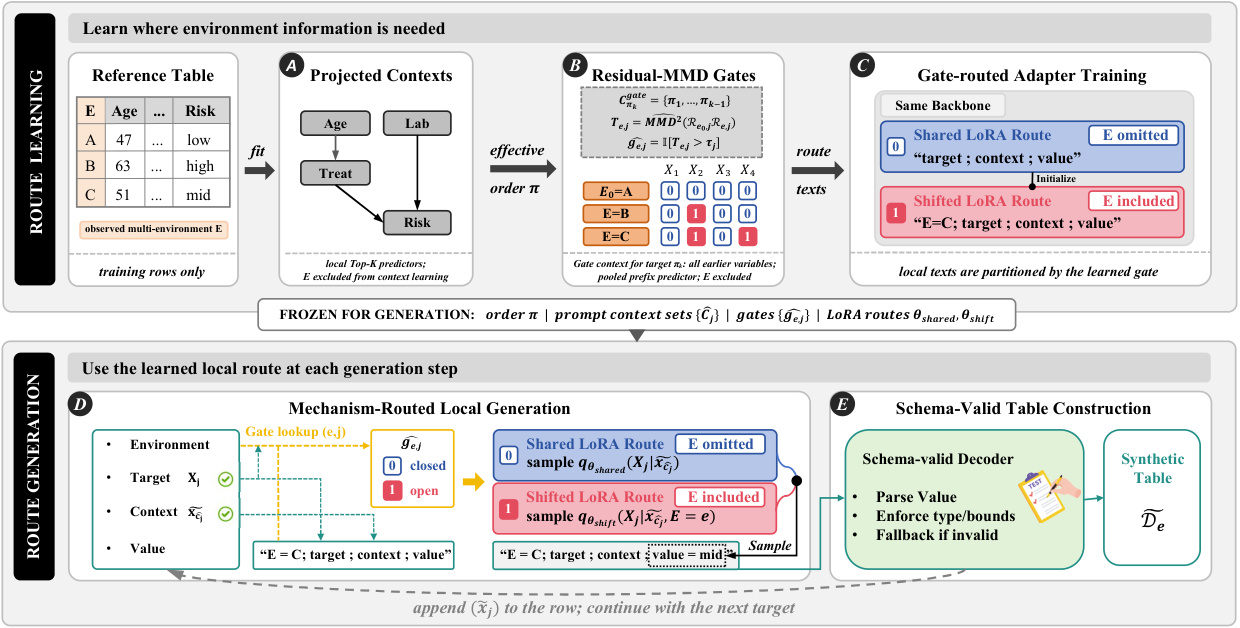 Dynamic Mechanism Fidelity for Nonstationary Tabular Data: Evaluation and Mechanism-Guided GenerationIn Proceedings of the AAAI Conference on Artificial Intelligence (AAAI), 2027Under review
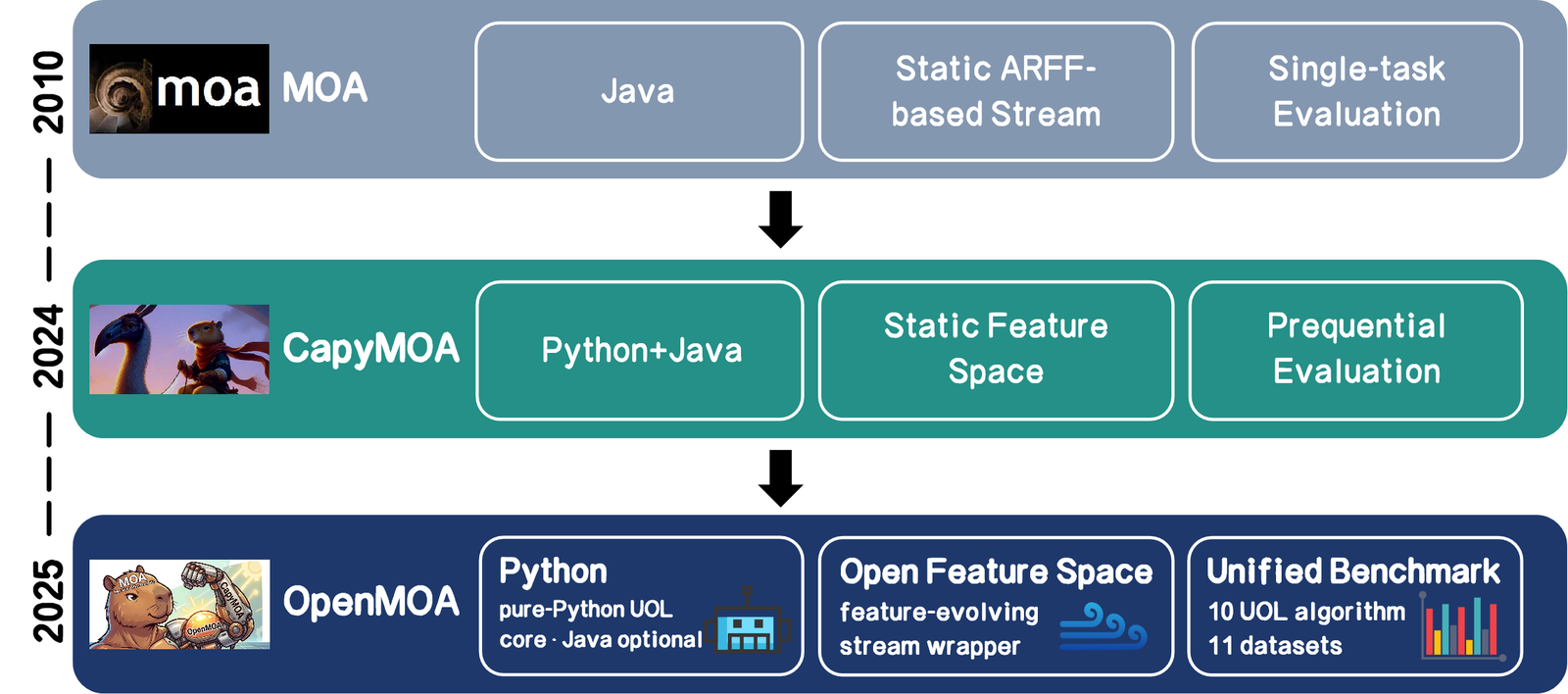 OpenMOA: A Python Library for Utilitarian Online LearningJournal of Machine Learning Research – Machine Learning Open Source Software, 2025Under review
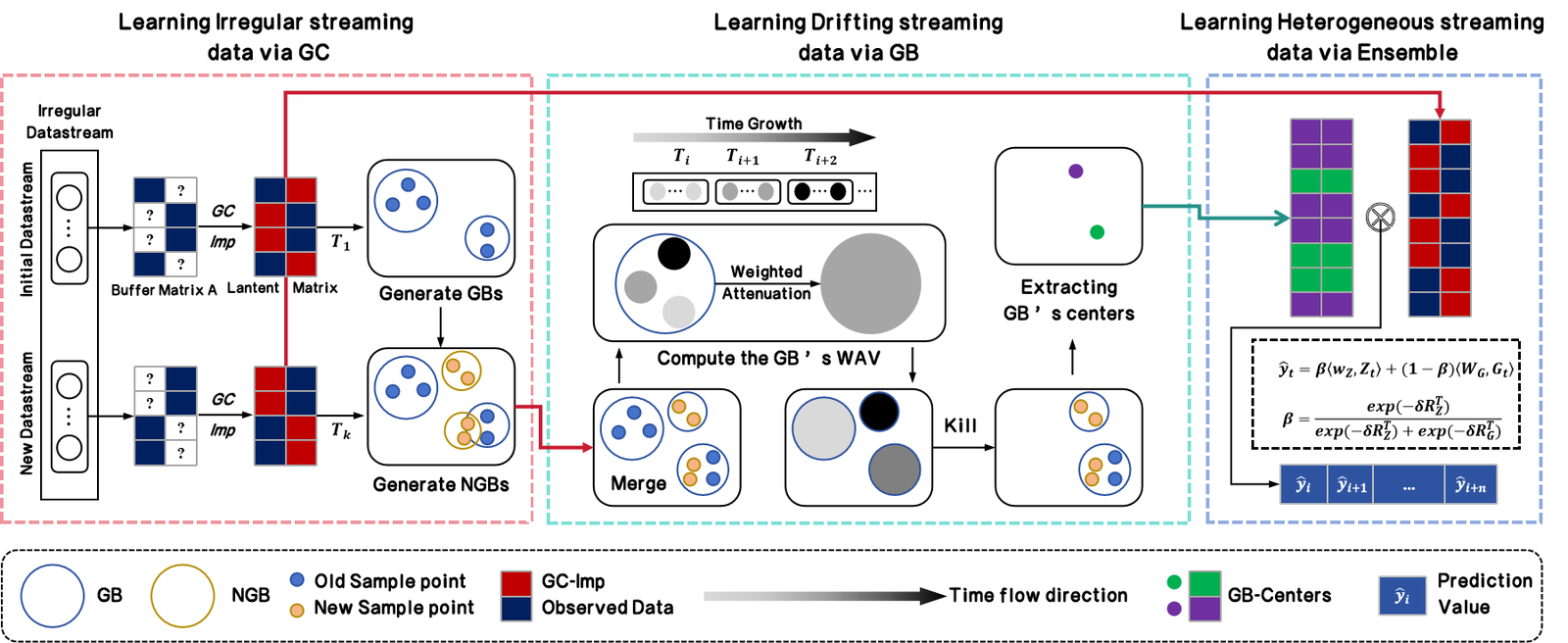 Online Learning from Irregular, Drifting, and Heterogeneous Streaming DataIEEE/CAA Journal of Automatica Sinica, 2025Under review